Chapters are in preparation; titles and scope may be refined as the book develops.
Chapter 1Manoeuvrability and standard manoeuvres
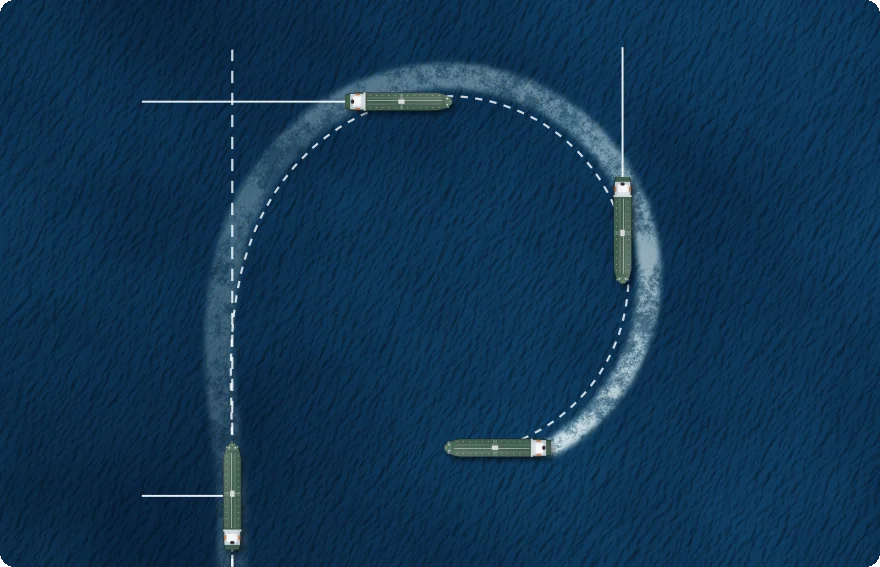
Introduce the practical questions behind turning, stopping and keeping a course. Defines the principal measures obtained from turning-circle, zig-zag, spiral, pull-out and stopping trials. Relates these measures to manoeuvrability standards, their conditions of application and the distinction between a design assessment and the handling of a ship in service.
Chapter 2Kinematics and reference frames
Describe the motion of a ship consistently before calculating its forces. Develops earth-fixed and body-fixed frames, heading, course, drift angle, velocity and yaw rate, reference-point transformations and non-dimensional variables. Explains how to translate published coefficient sets between conventions and why some service-speed normalizations become unsuitable near zero speed.
Chapter 3Rigid-body and hydrodynamic equations of motion
Derive the equations governing surge, sway and yaw, including rigid-body inertia, added mass and the associated coupling terms. Identifies the forces and moments contributed by the hull and control devices. Introduces roll coupling and six-degree-of-freedom extensions, including the additional requirements of high-speed craft and submerged vehicles.
Chapter 4Rudders and control surfaces
Connect rudder geometry and inflow to lift, drag and steering moment. Covers section shape, aspect ratio, balance, stall, cavitation, hull effects and the propeller slipstream. Develops preliminary sizing and the hydrodynamic trade-offs of conventional, high-lift and alternative control surfaces, including the loads imposed on steering machinery.
Chapter 5Propulsion and steering interactions
Explain how propulsion and steering devices act together during a manoeuvre. Covers propeller–hull–rudder interaction, twin-screw and twin-rudder arrangements, tunnel thrusters, azimuthing units and waterjet steering. Examines actuator limits and asymmetry, and the effects of ship speed and shallow submergence on the forces available for control.
Chapter 6Course stability and steering response
Determine whether a ship returns towards straight motion after a small disturbance. Develops linear sway–yaw analysis, controls-fixed stability, steady turns, spiral behaviour and response models such as the Nomoto models. Connects stability and steering response to the interpretation of standard manoeuvres and the trade-off between course-keeping and turning ability.
Chapter 7Whole-ship hydrodynamic models
Represent the combined hydrodynamic forces through derivatives and nonlinear expansions. Develops the Abkowitz approach, symmetry arguments and common alternatives, with attention to the meaning and units of each coefficient. Examines the reference condition, parameter dependence and the consequences of using a local expansion outside the motions for which it was identified.
Chapter 8The MMG modular method
Construct a manoeuvring model by separating hull, propeller and rudder contributions. Develops the MMG standard formulation, oblique inflow, interaction factors and the numerical simulation of standard manoeuvres. Explains which quantities require measurements or estimates and how the model's assumptions affect its use across different ships and operating conditions.
Chapter 9Prediction of hydrodynamic coefficients
Estimate manoeuvring behaviour during preliminary design when dedicated tests are unavailable. Introduces slender-body and cross-flow ideas, regression methods and empirical interaction factors. Examines the hull families, speed ranges and loading conditions behind those estimates, and uses sensitivity studies to show which uncertain coefficients most affect a prediction.
Chapter 10Captive and free-running model experiments
Determine hydrodynamic coefficients and manoeuvring response from experiments. Covers oblique towing, planar-motion mechanisms, rotating-arm and circular-motion tests, free-running trials and the design of useful excitation. Examines scale effects, tank interference, instrumentation and uncertainty, distinguishing the tests used to fit a model from independent tests of its predictive performance.
Chapter 11CFD prediction and virtual manoeuvring trials
Use CFD to estimate forces, derivatives and complete manoeuvres. Compares virtual captive tests, rotating and body-force propeller representations, free-running simulations and hybrid CFD–system approaches. Examines mesh motion, actuator modelling, convergence, computational cost and comparison with experiments, including the risks of fitting a fast model to uncertain numerical data.
Chapter 12Stopping, low-speed manoeuvring and berthing
Model the large drift angles and changing propulsion states encountered during harbour operations. Covers cross-flow drag, four-quadrant propulsion, shaft reversal, stopping, backing and the transition through zero forward speed. Connects thrusters, tugs and control allocation to berthing, and explains why a service-speed steering model needs additional physics in this regime.
Chapter 13Shallow water, squat and under-keel clearance
Explain how restricted depth changes the forces and moments on a manoeuvring ship. Examines added mass, damping, squat, dynamic trim, changing under-keel clearance and the influence on turning and stopping. Compares empirical corrections and dedicated models, with attention to their depth, speed and hull-form limits.
Chapter 14Banks, channels and interacting ships
Examine manoeuvring when the surrounding water cannot be treated as laterally unbounded. Covers bank forces, channel blockage, bends, passing and overtaking ships, and close-proximity operations. Relates these interactions to ship speed, separation and channel geometry, and introduces the experimental and simulation evidence used in waterway and port planning.
Chapter 15Manoeuvring in wind, current and waves
Add environmental forces to a ship's course-keeping and turning problem. Distinguishes velocity through water from motion over ground, introduces wind loads and wave drift, and examines coupled seakeeping–manoeuvring models. Relates available propulsion and steering authority to adverse-weather operation and the scope of minimum-propulsion-power assessment.
Chapter 16Validation and uncertainty in manoeuvring predictions
Decide whether a simulated manoeuvre is sufficiently reliable for its intended use. Covers full-scale trial planning, trajectory processing, extraction of manoeuvre measures, numerical verification, benchmark comparisons and uncertainty propagation. Reports individual assessed criteria with their conditions and identifies what remains untested, rather than inferring general compliance from a limited set of manoeuvres.
Chapter 17System identification and hybrid models
Update manoeuvring models from measured ship motion. Introduces parameter estimation, experiment design, identifiability, filtering, regularization and uncertainty, then considers sparse and machine-learning approaches. Examines model-to-ship adjustment and hybrid physics–data models, with independent validation across manoeuvres and conditions to expose overfitting and unsupported extrapolation.
Chapter 18Navigation, guidance and autopilots
Connect a hydrodynamic model to a system that follows a heading or a route. Distinguishes navigation, guidance and control, introduces sensor fusion and wave filtering, and develops PID and model-based autopilots and path-following laws. Examines actuator saturation, environmental disturbances and the limits imposed by the ship's manoeuvring response.
Chapter 19Dynamic positioning and automatic berthing
Control position and heading when forward speed is small or zero. Introduces station-keeping models, wind and wave disturbances, thruster allocation, position observers and capability assessment. Extends these ideas to automatic berthing, accounting for actuator failures, restricted-water effects, sensor uncertainty and the transition between transit and close-quarters operation.
Chapter 20Autonomous manoeuvring and future control
Examine how autonomous systems can make and execute manoeuvring decisions. Introduces model-predictive control, learning-based methods, collision avoidance and coordination, with attention to navigational rules and human supervision. Considers operational design domains, simulation-to-ship transfer, scenario-based testing and the current regulatory framework, distinguishing a successful research demonstration from evidence of safe operation.