Chapters are in preparation; titles and scope may be refined as the book develops.
Chapter 1Ship motions and seakeeping decisions
Introduce the six rigid-body motions and the design and operational questions that seakeeping analysis answers. Establishes coordinate frames, headings, motion signs, mass properties and reference points. Connects motions to comfort, equipment, cargo and safety, and explains the distinction between a motion prediction and a decision about acceptable performance.
Chapter 2The ship as an oscillating system
Develop the physical meaning of inertia, added mass, damping, restoring force and excitation through simple heave, pitch and roll models. Examines free and forced oscillations, natural periods, resonance and phase. Shows how decay tests and forced-motion experiments reveal the coefficients of a model and where the single-degree-of-freedom approximation becomes inadequate.
Chapter 3Regular waves and encounter conditions
Describe a regular wave and the water motion and pressure beneath it. Develops linear wave theory, finite-depth dispersion, phase and group velocity, energy and encounter frequency for a moving ship. Introduces nonlinear and focused waves, and explains why following-sea frequency transformations require particular care.
Chapter 4Irregular seas and directional wave spectra
Represent a measured sea as a random process and a superposition of wave components. Covers wave records, spectral estimation, significant wave height, characteristic periods, standard spectral forms, directional spreading, wind sea and swell. Introduces scatter diagrams and hindcast data, with their uncertainty and the assumptions behind a stationary sea-state description.
Chapter 5Wave forces and hydrodynamic coefficients
Separate the forces caused by incident waves, diffraction and the ship's own motion. Formulates the linear radiation and diffraction problems and explains frequency-dependent added mass, radiation damping and excitation. Establishes the physical and numerical checks needed before hydrodynamic coefficients are used to calculate the response of a ship.
Chapter 6Coupled motions in regular waves
Calculate motion amplitudes and phases from the coupled equations of motion. Develops response amplitude operators, heave–pitch and lateral-motion coupling, the effects of speed and heading, and motions and accelerations at points away from the centre of gravity. Explains normalization and phase conventions so that results from different methods can be compared correctly.
Chapter 7Irregular-sea response and operability
Use wave spectra and response operators to predict motion statistics. Covers response spectra, spectral moments, short- and long-term estimates, exceedance probabilities and the conditions behind common peak distributions. Relates relative motions and accelerations to slamming, deck wetness, motion sickness, task performance and operability criteria, while keeping the limits of linear statistics explicit.
Chapter 8Strip theory and sectional hydrodynamics
Build a three-dimensional ship-motion estimate from two-dimensional hull sections. Covers sectional geometry, conformal mapping, close-fit source methods and the integration of sectional forces in strip theory. Examines forward-speed and end effects, the treatment of coupled motions, and the hull forms and wave conditions for which slender-body approximations are useful.
Chapter 9Three-dimensional panel methods and forward speed
Resolve radiation and diffraction over the wetted hull with three-dimensional boundary-element methods. Introduces Green-function and Rankine formulations, panel resolution, irregular frequencies, multi-body interaction and forward-speed boundary conditions. Explains why replacing wave frequency with encounter frequency alone does not reproduce the hydrodynamics of a translating ship.
Chapter 10Roll damping and motion stabilization
Explain why roll prediction needs more than inviscid radiation damping. Examines viscous damping components, bilge keels, roll-decay analysis and empirical damping methods, including their scale and amplitude dependence. Compares fins, anti-roll tanks, gyroscopic systems and other stabilizers, accounting for their operating limits and the interaction between control and ship response.
Chapter 11Time-domain and nonlinear ship motions
Move from harmonic response to the ship's motion through a wave record. Develops radiation memory, the Cummins equation, impulse-response and state-space representations, then introduces nonlinear restoring and incident-wave forces on the instantaneous wetted hull. Examines wave groups, large motions and the consistency required when linear and nonlinear models are combined.
Chapter 12Added resistance and propulsion in waves
Calculate the mean force and power consequences of sailing through waves. Introduces wave drift, added resistance, motion-related and short-wave contributions, and methods based on experiments, theory and engineering approximations. Examines irregular-wave averaging and propulsion changes, connecting seakeeping predictions to speed loss and the power required to maintain a voyage.
Chapter 13Wave loads and impact phenomena
Translate ship response into global and local loads. Develops sectional forces, shear forces and bending moments, then introduces water entry, bow and bottom slamming, flare impacts and water shipped on deck. Distinguishes load mechanisms that linear theory can represent from impacts that require nonlinear models or dedicated experiments.
Chapter 14Hydroelasticity and ship vibration
Examine what changes when the ship is flexible rather than rigid. Introduces structural modes, wet natural frequencies and the coupling of fluid forces with hull deformation. Explains resonant springing, impact-induced whipping, their contribution to extreme and fatigue loads, and the experimental and numerical evidence needed for large or flexible ships.
Chapter 15Dynamic stability and manoeuvring in waves
Connect wave-induced motions to stability failures and changes of course. Covers parametric roll, pure loss of stability, dead-ship response, excessive acceleration and surf-riding and broaching. Introduces the second-generation intact stability assessment framework and the coupling of seakeeping with manoeuvring, building on the hydrostatic foundations of the companion stability book.
Chapter 16Experiments, verification and validation
Design a seakeeping comparison that can establish what a model gets right. Covers wave generation and calibration, mass and inertia matching, motion and load measurements, test duration and uncertainty. Distinguishes numerical verification from experimental validation and develops benchmark comparisons across speed, heading, wave condition and response quantity.
Chapter 17Viscous CFD and violent free-surface flows
Examine numerical approaches for effects that simplified potential-flow models cannot resolve adequately. Covers viscous free-surface CFD, overset and moving meshes, particle methods and hybrid approaches for breaking waves, impact and strongly nonlinear motions. Emphasizes wave propagation errors, numerical damping, computational cost and the validation needed for each intended application.
Chapter 18Special craft and offshore systems
Extend seakeeping concepts to multihulls, small-waterplane craft, planing vessels, hydrofoils and floating offshore systems. Examines the influence of dynamic lift, moorings, multiple bodies, moonpools and coupled equipment. Introduces floating wind and wave-energy applications while identifying the additional physical models needed beyond the free rigid ship.
Chapter 19Onboard sensing and operational guidance
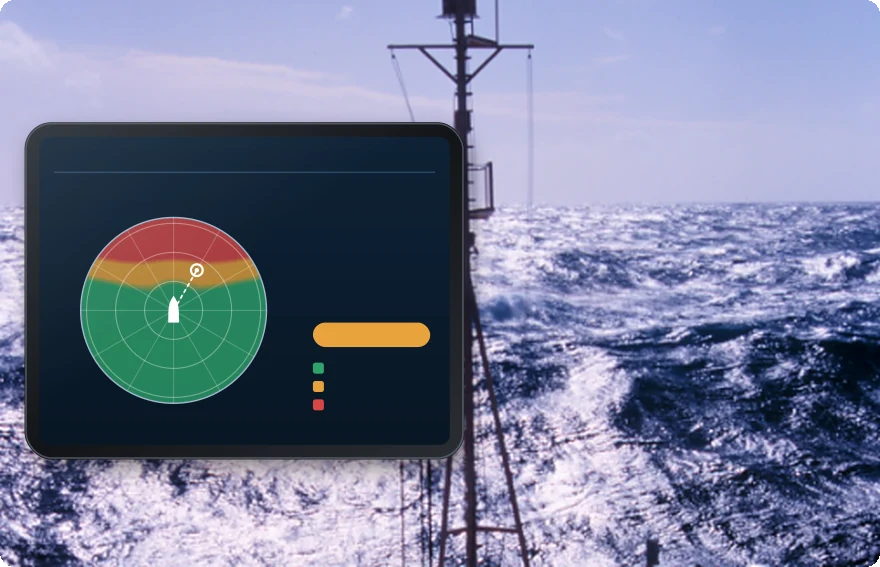
Use observations and forecasts to support decisions at sea. Introduces motion sensors, wave radar, the ship-as-a-wave-buoy concept, sea-state estimation and the assessment of changing loading conditions. Connects uncertainty in those inputs to heading and speed guidance, weather routing, mission planning and the continuing responsibility of the operator.
Chapter 20Data-driven seakeeping and future methods
Assess emerging methods for fast and adaptive response prediction. Covers reduced-order models, machine-learning surrogates, hybrid force corrections, data assimilation and digital twins. Examines generalization across hulls and sea states, rare events and uncertainty, and the evidence required before an efficient research model can support design or real-time operational guidance.